Year - End Offer Is Live — Get limited-time discounts on MCAD + EV Courses. Avail Offer
Tata I Get It - Student Professional Enterprise
i get it search
TATA - Student Professional Enterprise

i GET IT by Tata Technologies
  • About us New
    • About i GET IT
    • Our Programs
      • EngAge Professional Program
      • EngAge Student Program
      • Campus Program
      • Author Program
      • Reseller Program
  • i GET IT For Enterprise
  • Plans and Pricing New
    • All in One Bundles Best Buy
      • Electric Vehicle Certifications        
        • EV – High Voltage, Thermal & Battery Certification Program
        • EV – Advanced Battery Certification Program
      • MCAD Professional Bundle
      • MCAD+EV Professional Bundle
    • EV Subscriptions
      • EV – Essentials
      • EV – Energy Storage System Fundamentals
      • EV – Thermal Management System
      • EV – Battery Pack Design
      • EV – BMS (Battery Management System)
      • EV – High Voltage Systems
    • MCAD Subscriptions
      • Dassault Systems
        • 3D Experience Subscription
        • CATIA V5 Subscription
        • SOLIDWORKS Subscription
      • Siemens Digital Industries
        • Siemens NX PLM Subscription
      • GD&T Subscription
      • Plastics and Molding Subscription
      • ISO GPS Subscription
      • PTC CREO & Wildfire Subscription
      • Autodesk Subscription
  • Insights
    • Business Blogs
    • Tech Blogs
    • Webinars
  • Course Catalog
  • searchigetit search
  • Contact Us
  • Sign In / Sign Up
Sign In / Sign Up Sign In / Sign Up

Series & Parallel Hybrid Vehicles: Are they Outsmarting EVs?
July 5, 2024 2024-11-11 13:29

Series & Parallel Hybrid Vehicles: Are they Outsmarting EVs?

Series and Parallel Hybrid Vehicles blog banner
EV Tech
Kedar Gokhale
July 5, 2024
2,744 views
0 comments

Series & Parallel Hybrid Vehicles: Are they Outsmarting EVs?
With increased population of automobiles in emerging markets and growing challenges of environmental pollution control, the “over-matured” propulsion technologies around Internal Combustion Engines (ICE) have hit a technological saturation. This has mandated the policymakers and global automotive industry to switch to Battery Electric Vehicles (BEVs) propelled by e-motors, however they too are facing multiple challenges on faster adoption and effective Carbon emission reduction. Obviously, there is no “Perfect” solution on this planet, however Series and Parallel Hybrid Electric Vehicles (HEVs) have been enabling both the prime-movers viz. IC Engine and e-motor to work together and offer an optimized solution for propulsion. 


HEVs propelled by “Hybrid Powertrains”, strike a reasonably good trade-off between CO2 + exhaust emissions & the last mile mobility needs, that too at a reasonable cost impact. The Government of India has introduced the FAME I & II schemes (Faster Adoption and Manufacturing of Hybrid & Electric Vehicles), over last decade to subsidize/incentivize and promote HEVs and BEVs in Indian market. HEVs have been quite popular in advanced markets over last two decades, however despite FAME scheme, they were unable to find their place in cost sensitive Indian market earlier.


Now with increased affordability and technology orientation of Indian car-buyers in recent years, multiple global OEMs have offered strong HEVs in Indian market. The other two popular types of hybrid vehicles viz. Plug-in Hybrid (PHEV) and Range Extender Electric Vehicle (REEV) are still lagging due to higher price tags. Now that, we have quite a few strong HEVs on Indian roads, it is pertinent to explore state-of-the-art hybrid powertrain technologies.

Requirements of a typical on-road vehicle and limitations of ICE & e-powertrains

Before deep diving in hybrids, let us briefly look at propulsion requirements of a typical on-road vehicle and limitations of ICE & e-powertrains.

Propulsion of a vehicle demands to overcome the initial resistance to vehicle motion which is coming from its inertia, road-tire friction, and positive road gradients when applicable. Further, as vehicle is to be accelerated, it needs additional effort to overcome aerodynamic drag which is fast increasing with speed.

The real challenge is the randomness of the vehicle speed due to traffic conditions &/or driver’s wish as well as the variation of load due to operating conditions, such as driving empty / laden, driving uphill/downhill, cruising or coasting, braking / accelerating and numerous permutations & combinations thereof. This implies, that the energy stored onboard either in the form of fuel in tank or electrical charge in High Voltage (HV) battery which is being consumed for vehicle propulsion, varies according to the driving needs and conditions. This energy utilization is not necessarily happening at best efficiency of its powertrain. For e.g., any IC Engine has a specific speed-load range of its best efficiency (sweet spot of engine). However, due to randomly changing drive conditions, it ends up consuming excessive fuel during idling, engine starting, vehicle take-off or maximum vehicle speeds.

The e-motor on other hand, can simply be switched off, thereby eliminating loss of energy during vehicle halts in traffic conditions or traffic signal. Further, E-motor can provide its peak torque right from start and help to achieve very good acceleration during take-off. Interestingly, the energy transfer during vehicle propulsion is of bi-directional &/ binary nature i.e., either engine/motor is driving the vehicle or vice versa. So, during the latter phase, the e-motor can help recuperate the kinetic energy of vehicle by acting as a generator during coast-down, downhill coasting and braking which otherwise could have been lost in friction. The idea here in hybrid vehicles is to employ both these powertrains and make them propel the vehicle together in an optimum manner and exploit opportunities of energy recuperation.

Difference between Series and Parallel Hybrid Electric Vehicles​

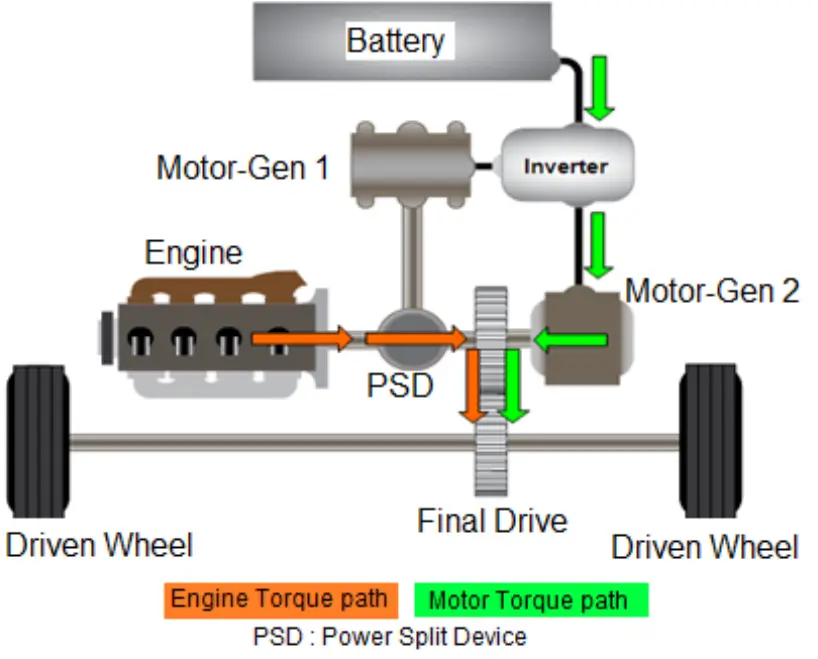
While using more than one prime mover onboard (typically limited to two though!), one can arrange them, either in series or in parallel configuration. In Series Hybrid Vehicle, the IC Engine simply acts as an onboard generator to keep the HV battery charged, while the e-motor propels the vehicle all the time. In Parallel Hybrid Vehicle, the IC Engine as well as e-motor are connected to the driven wheels, while e-motor propels the vehicle on its own or in combination with IC engine. The limitation in parallel hybrid is that the IC Engine always stay connected to the driven wheels. Hence, the engine speed gets dictated by the vehicle speed which may not always fall around its sweet spot. To overcome this limitation, series-parallel hybrids are developed with a power split device that enables IC engine operation within narrow range of its best efficiency thereby significantly improving overall fuel economy. Two e-motors, which can also act as a generator, are used in this layout. The smaller one i.e., Motor-Gen 1 acts as a starter motor for engine, and once engine is started it acts as a generator charging the HV battery. The bigger one i.e., Motor-Gen 2 acts as main traction motor to drive the wheels and gets converted to generator during recuperation mode as mentioned earlier.

Series and Parallel Hybrid Vehicle blog pic

The power split device enables splitting as well as integration of power from two sources. Toyota has achieved this using planetary gear transmission which is electronically controlled to operate as an infinitely variable transmission and keep the engine running close to its sweet spot. Whereas Honda uses two clutches (Low and High) to engage & disengage the engine with final drive to the wheels at low and high-speed ranges. Other OEMs simply use conventional Automatic transmission or DCT (Dual Clutch Transmission) in conjunction with two motor generators.

All these approaches bring their own benefits along with limitations &/ challenges. The key advantage in planetary system is that, since both the prime movers (ICE & Motor-Gen 2) are in constant mesh with the “Countergear” driving the wheels through differential unit, it is quite responsive, and the speed of Motor-Gen 1 can be controlled to achieve infinitely variable transmission ratio (ranging from underdrive to overdrive). However, this also brings limitation on its generator mode since it must follow the random drive cycle that vehicle is undergoing, meaning it cannot charge the HV battery in isolation.

On the contrary, the other system allows engine and Motor-Gen 1 to charge the HV battery in isolation (in series hybrid mode) due to availability of clutch. The clutching and de-clutching however may cause a little delay (lag) in power delivery during shifting. Multiple variants of these Series-Parallel hybrid transmissions are used in cars and SUVs as per the size and performance needs.

Final Thoughts

Looking at global scenario of BEV penetration and its associated ongoing challenges, the opportunity for HEVs is evident especially in the emerging market and fast developing economy such as India.

The costs of BEVs are already brought down to their ICE equivalents in China, however, they are still 10% to 50% higher in Europe, US and are expected to reach the price parity by 2030.

The costs of BEVs are still higher compared to their ICE counterparts in India and are in fact competing with equivalent HEVs. The disparity in growth rates of affordability, charging infrastructure, green electricity generation and BEV sales numbers will be the key for growth of HEVs in India. Given that India is the fastest growing major economy, the global OEMs, those having well proven hybrid powertrain technologies have been pouring in their offerings in India. With HEVs offering best of both worlds (ICEV & BEV) at reasonable costs and comfort, It will be interesting to witness how BEVs and HEVs/PHEVs co-exist and compete in near future!

EV Certification Courses by Tata Technologies

Understanding the intricacies of both EV and Hybrid Vehicle systems is crucial for making informed decisions about the future of transportation. i GET IT by Tata Technologies, with its comprehensive library of EV courses, empowers you to delve into the world of electric and hybrid vehicles. These courses, designed by industry experts, provide in-depth knowledge of electric powertrains, battery technology, and the inner workings of both hybrid and electric vehicles. Equipping yourself with this knowledge can be a valuable asset, whether you’re a car enthusiast, a budding automotive professional, or simply someone looking to navigate the ever-changing landscape of sustainable transportation. Visit the i GET IT website today to explore our EV courses and unlock the secrets of the future of mobility.

Electric Vehicle, ev, Hybrid, Parallel hybrid vehicle, Series Hybrid
Share this post
Kedar Gokhale
Kedar is an Automobile Engineer with M. Tech. in Automotive Engine Technology from IIT Madras. He has accomplished formal education in Business Administration and German as a foreign language. He has 30+ years’ experience in Design, development & application engineering of ICE powertrains (Gasoline, Diesel & CNG engines) whose applications range from passenger cars, on-road / off-road machines to locomotives & marine ships. He has successfully led the Design team of TATA NANO Gasoline engine and filed 8 patents with 2 technical paper publications. He also holds recent 7+ years’ experience in EV powertrains & hybrid powertrains involving technology selection & rightsizing by leveraging performance simulations as well as their thermal management. Kedar is also supporting Indian academia by teaching Powertrain subjects as an industry faculty to engineering students.
What is Computer Aided Manufacturing (CAM)? [Detailed Guide]
How to Become an Aerospace Engineer?-Job Requirements & Tips

Related Posts

What is Product Lifecycle Management? PLM explained

What is PLM? – Product Lifecycle Management [Detailed Guide]

October 9, 2025
219 views
Lead-Acid vs. Lithium-Ion Batteries_banner image

Lead-Acid vs. Lithium-Ion Batteries: Key Differences & Best Uses

June 13, 2025
532 views
Top AutoCAD 3D Commands & Shortcuts-banner image

Top AutoCAD 3D Commands & Shortcuts with Examples

April 9, 2025
2,201 views
what is engineering mechanics - blog banner image

What is Engineering Mechanics? – Introduction 101

March 10, 2025
1,485 views
inventor blog banner image

How to Create Stitch Weld in Weldments using Autodesk Inventor?

November 15, 2024
610 views

Find

Categories

  • 3DEXPERIENCE (4)
  • Aerospace Engineering (1)
  • AutoCAD (1)
  • AUTODESK INVENTOR (4)
  • Business (16)
  • CATIA V5 (5)
  • EV (3)
  • GD&T (1)
  • General (1)
  • General (10)
  • PLM (1)
  • PTC CREO (5)
  • Siemens NX (7)
  • SOLIDWORKS (8)
  • Tech (46)

Latest Posts

What is Product Lifecycle Management? PLM explained
PLM
What is PLM? – Product Lifecycle Management [Detailed Guide]
October 9, 2025
SOLIDWORKS certification roadmap image 2025 — from CSWA to CSWE, showing training path, skills level, and i GET IT platform recommendation
Business
SOLIDWORKS Certification: Top Courses, Prep Tips & Salaries
July 29, 2025
Top Online Automotive Design Engineer Courses
Business
Top Automotive Design Engineer Courses by Tata Technologies
July 15, 2025

Popular Tags

3DEXPERIENCE ACES Aerospace Aircraft Cabin Assembly autocad autodesk Autodesk Inventor Business CAD CAD courses CAD Drawings CAD Drawing view CAM cam and follower Career cars CATIA V5 catiav5 Chamfer corner relief CREO design engineering Design Engineers dimensioning Engineering Education ev EV Engineer GD&T inventor Mechanical engineering NX NX 2306 Online Certification product design PTC Sketcher Sketching Solid Combine solidworks Spinal Bend tech tech tips threaded stud work Upskilling
App Download
Facebook Twitter Youtube Linkedin

Course Topics

EV Design
NX
CATIA V5
3DEXPERIENCE CATIA
SOLIDWORKS
PTC Creo
Autodesk Training
Plastic Part
GD&T
ISO GPS
And more ...
EV Design
CATIA V5
SOLIDWORKS
Autodesk Training
GD&T
NX
3DEXPERIENCE CATIA
PTC Creo
AutoCAD
ISO GPS
Plastic Part
And more ...

About

About Us
Contact Us
Blogs

Programs

Campus Program
Author Program
Reseller Program

Support

Help
Privacy Policy
Terms of Use
Cookie Policy

close-window chat
cosmos

Cosmos

AI powered chatbot

close-cosmos
Need help? Talk to Us

Hey! I am here to Help You!

User Details

Please enter your details so we can assist you more efficiently.

Full Name is required

Enter a valid Email ID

Please select a profile

Select batch size

    Country is required

    +91

    Invalid Contact Number

    You must accept the terms to continue.

    SalesBot AI Assistant AI Powered Chatbot
    SalesBot Voice Assistant AI Powered Calling
    00:00
    Mute
    End Call
    i GET IT by Tata Technologies
    • About us New
      • About i GET IT
      • Our Programs
        • EngAge Professional Program
        • EngAge Student Program
        • Campus Program
        • Author Program
        • Reseller Program
    • i GET IT For Enterprise
    • Plans and Pricing New
      • All in One Bundles Best Buy
        • Electric Vehicle Certifications        
          • EV – High Voltage, Thermal & Battery Certification Program
          • EV – Advanced Battery Certification Program
        • MCAD Professional Bundle
        • MCAD+EV Professional Bundle
      • EV Subscriptions
        • EV – Essentials
        • EV – Energy Storage System Fundamentals
        • EV – Thermal Management System
        • EV – Battery Pack Design
        • EV – BMS (Battery Management System)
        • EV – High Voltage Systems
      • MCAD Subscriptions
        • Dassault Systems
          • 3D Experience Subscription
          • CATIA V5 Subscription
          • SOLIDWORKS Subscription
        • Siemens Digital Industries
          • Siemens NX PLM Subscription
        • GD&T Subscription
        • Plastics and Molding Subscription
        • ISO GPS Subscription
        • PTC CREO & Wildfire Subscription
        • Autodesk Subscription
    • Insights
      • Business Blogs
      • Tech Blogs
      • Webinars
    • Course Catalog
    • searchigetit search
    • Contact Us
    • Sign In / Sign Up
    Styled Form
    Image description

    Show your Interest

    Submit details and we will get back to you!!!

    SME
    Image description
    Join our Author, Campus & Reseller Program

    Submit details and we will get back to you!!!

    Form Submission
    Image description
    Tell Us Where to Send the Syllabus?

    Submit details and we will get back to you!!!

    Form Submission
    LMS
    logo

    Autodesk Training Subscription

    1010

    OR

    Verify email

    Pay now, get full term access


    Already have an account? Sign In

    By clicking the button above, you accept our terms of use and privacy policy.

    logo

    Autodesk Training Subscription

    1010

    OR

    Verify email

    Start your 3 days free trial now


    Already have an account? Sign In

    By clicking the button above, you accept our terms of use and privacy policy.

    OTP Verification

    Resend OTP in
    00:00
    Resend OTP

    OTP Verification

    Resend OTP in
    00:00
    Resend OTP
    LMS
    logo

    Autodesk Training Subscription

    1010

    OR

    Verify email

    (Ensure popup is allowed for this site)

    Pay now, get full term access

    Already have an account? Sign In

    By clicking the button above, you accept our terms of use and privacy policy.

    logo

    Autodesk Training Subscription

    1010

    OR

    Verify email

    (Ensure popup is allowed for this site)

    Start your 3 days free trial now

    Already have an account? Sign In

    By clicking the button above, you accept our terms of use and privacy policy.

    OTP Verification

    Resend OTP in
    00:00
    Resend OTP

    OTP Verification

    Resend OTP in
    00:00
    Resend OTP
    LMS
    logo_w
    d

    Start learning now

    We provide an easy to use interface with adaptive content and clear direction. You'll find bitesize practical information from experts who are industry leaders in their field.

    logo

    Sign In

    Have Organization Sign In?  Use Single Sign On

    Forgot Password?

    (Ensure popup is allowed for this site)

    Don't have an account? Sign Up

    OR

    Privacy Notice
    Term of service
    logo

    Sign Up

    Already a user? Sign In

    Verify

    (Ensure popup is allowed for this site)

    OR


    Have Organization Sign In?   Use Single Sign On

    By Registering you agree to the Terms of Use and Privacy Policy.

    logo

    Single Sign On

    If your company has single sign-on set-up with i GET IT, enter your company's web address to access your unique login page. The format needs to be as such: "domainname.com".

    (Ensure popup is allowed for this site)

    Not an enterprise user?Sign In
    Privacy Notice
    Term of service
    logo

    Forgot Password

    Enter your email and we'll send you instructions on how to reset your password.

    If you are still having trouble this article might help

    Privacy Notice
    Term of service

    OTP Verification

    Resend OTP in
    00:00
    Resend OTP
    Styled Form
    Image description

    Avail Year - End Offers on Courses

    Submit details and we will get back to you!!!
    Avail Year - End Offer